WELCOME!

Please share this blog with your friends and neighbors!!
Dr. Caroline Ramsey Musselwhite

Friday, January 20, 2023

The Fletcher Miller Newspaper!

Before jumping into the journey of our school newspaper, I wanted to introduce ourselves. We will be contributing here and there with some fun ideas around teaching emergent literacy! Fletcher Miller is a self-contained school in Jefferson County Public School District in Lakewood, Colorado. We serve students ages 3-21 all with multiple, complex disabilities. We have roughly 100 students in our school, of which about 90% are emergent literacy learners. We are passionate about creating age-respectful and meaningful literacy opportunities for our students. We love to think of creative ways to reach this complex population and provide opportunities that help them to access the world around them. We are so looking forward to connecting, and sharing what we do! 

Do you remember your school newspaper? I still have some of mine! The idea of a school newspaper came up when thinking about authentic learning experiences for our students with complex, multiple disabilities. Wanting to diversify reasons for writing, and allow a different, collaborative, opportunity to write. 
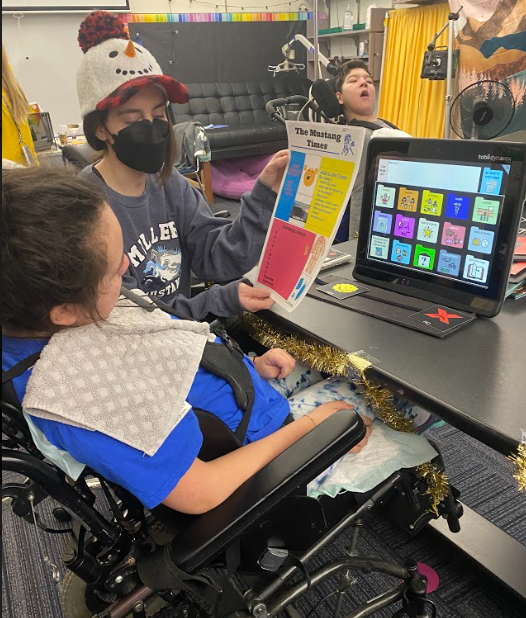
We started out by exploring newspapers both in print and online. We quickly realized that many of our students had never interacted with a newspaper before! It isn’t a total surprise, since most people are getting their news from the internet these days, but it ended up being a fun exploration. The feeling of the paper, the smell of the ink, and even how differently pages turn was a unique experience. The fact that the pages will fall out was an interesting exercise in adaptation for the adults. We ended up using paperclips to keep the pages together, and finding different ways to help turn the big pages for our students with physical motor impairments. For our students that primarily use switch scanning to access their literacy, we looked through newspapers online. We worked collectively to highlight the different sections and what belongs in each section. Not only was this a great literacy exploration activity, it was also a super rich language activity. Explaining sections like the horoscope, advice columns, and the classified section was so much fun! The students get such a kick out of the horoscope section, it’s become a favorite to write! From there, we asked each student which section they wanted to contribute to. Students would either use a conventional yes no response to auditory scan, or their dedicated communication systems. Once their section was selected, they would then narrow down to a topic. We ask students to use their alternative pencils to generate letters and words around the topic first.
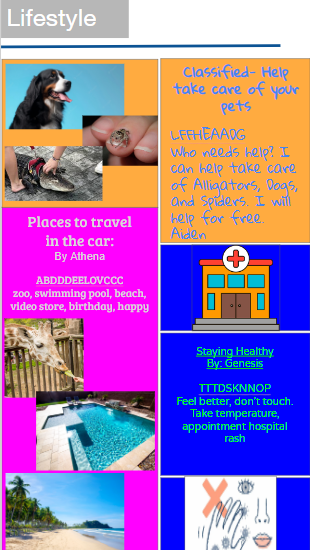
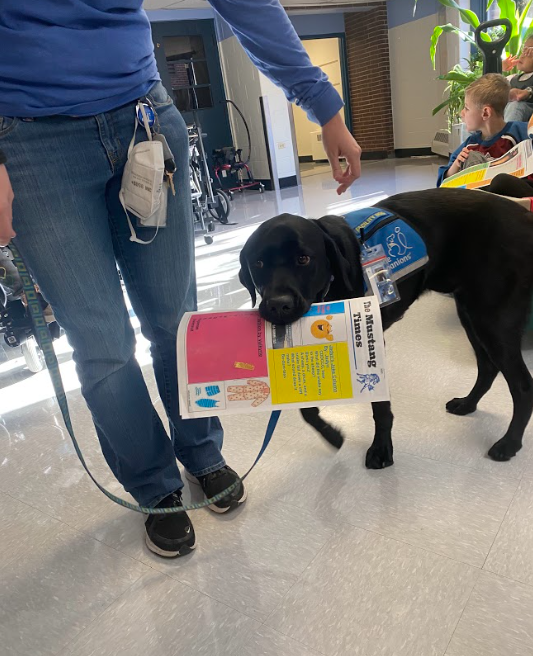
If they selected an obscure topic or section, we made sure to learn more about the topic or section first before asking them to write. For instance, this month a student selected that he wanted to write a classified ad. He also picked dogs, spiders and alligators in his topic selection. We explored different classified ads and what they mean. Some sell items, some post about jobs, and some highlight an event, like a garage sale. He decided to stick with the “job” section of the classifieds. It was easier for his learning partner to then help him explore jobs where he might see a dog, spider or alligator. He decided on petsitter. For an emergent communicator, this is a huge amount of fringe and tier two and three language. We acknowledge that, and align our expectations to balance out the engagement of the student. We know the students will be absorbing much of these lessons receptively and that generating novel language around these topics will be tough. But, viewing this as an authentic writing opportunity and a world knowledge building experience, makes it fun and valid learning. The alternative pencils are used to generate letters and word-like groupings, and the writing was followed up with specific feedback from the students' learning partners. In the example of the classified ad, the student selected letters “LLF.” Words like “leash, learn, food, fun” were used to make a connection between their writing, and words commonly used by a pet sitter. Then the students are asked “Would you like to add any additional words from your communication book?” Some pick additional words, and some don’t. The last task of generating the newspaper is our editing section. We ask students to pick pictures they want to be included with their posts, fonts and colors. On the last day of newspaper creation, we set up a newspaper stand and sell the newspaper. This time is a blast. Kids love hearing others read their newspaper and talk about it with them!  Here are some snapshots of our newspaper! Let us know if you create one with your class! 


Follow us on Instagram! @fletchermillerschool


Thursday, January 5, 2023

MLK Songboard

 What:  This is a songboard that I made more than 20 years ago.  It was part of a ''Social Studies' CD that I was working on, but never finished.  There were some fun songboards, that have been added to my Singing to Learn 'CD' (a.k.a., dropbox).  For more information about that dropbox, use this link:  Caroline's 'CDs'/ Dropboxes Flyer

The MLK songboard folder includes PDFs of all symbols and images needed to create this songboard.  It also includes the lyrics and goals, relative to standards (see below).

How:  The MLK Songboard is designed to start a conversation about the many dreams of Martin Luther King.  While symbols are included to suggest typical examples (freedom, equality, etc.) students are encouraged to use their devices, voices, and the alphabet to share their own ideas.  Take time to read books, watch videos (including his "I Have a Dream Speech) and have a conversation first.  Using this songboard can be part of your assessment, determining how much your students learned from the prior lessons.

 The lyrics could be made into a transitional book using PowerPoint, Slides, Pictello, Book Creator, etc.

Where:  Download this as a gift using this link:

MLK Songboard Folder


Augmentative and Alternative Communication: breaking Down Opportunity Barriers

New Book!

What:  Excited to share about a new book by Susan Johnston, Cindy Gervarter, Samuel Sennott, Lateef McLeod, and Eric Sanders. The book covers multiple types of barriers:

• Knowledge / Skill Barriers

• Practice Barriers

• Attitude Barriers

• Policy Barriers

Who:  I contributed to case examples for attitude barriers along with Krista Howard and Brandi Wentland, and with policy barriers with Dr. Gretchen Hanser.

Where:  This book is available through Plural Publishing.  The price (academic textbook pricing) is $99.95.  But the coupon shown below offers a 15% discount!  Enjoy!


Thursday, November 10, 2022

Unleash Your Creativity - Handout!

 Unleash Your Creativity – The Handout!!


Brenda Del Monte & I did a very fun prezzie at CTG - the last in a series.  I promised to post the handout quickly on this blog but . . . well . . . um . . . I forgot!  Anyway, here it is!  Enjoy!

Unleash Your Creativity


Thursday, June 23, 2022

Comments Are Cool – AAC Fun!

What?   Krista Howard and I are working on a series of short books to support teachers, therapists, and families who are supporting individuals who use AAC.  These books are free to anyone, and have been  'published' at:  www.tarheelreader.org.   One of these books is titled Comments Are Cool.


Why?   These books are intended to painlessly support partners in helping learners:
• Understand why this skill – being an active listener by commenting on events – is important.  (See Light and Binger, 1988, and Soto and Zangari, 2009 for more information).  It is helpful for both the teaching partners and the students who use AAC to understand why we are working on these goals.  Having cognitive clarity about goals helps people understand what we are doing, and what it will help them accomplish.  These goals are shared through 'advice from Krista' speech bubbles, such as those shown below.


• Practice the skills we are sharing.  Students get an opportunity to actually try out the skill of commenting through visual prompts, such as those shown here.  In each case, the learner gets to practice, based on the image and the prompt. 


• Examples of the skills we are sharing.  Following each image, we give two examples of possible comments.  The first is very simple (typically only one word), while the second is more sophisticated (longer, and with less frequent words).  Using multiple examples serves two purposes:

1) Demonstrates that a range of compliments are appropriate, and helps learners not to get 'stuck' with one specific example.

2) Models sample comments for students at different levels of AAC use.

Have Fun!  So, what are you waiting for?  Start commenting!

References:

Erickson, K. and Koppenhaver, D.  (2020).  Comprehensive Literacy for All:  Teaching Students with Significant Disabilities How to Read and Write.  Baltimore:  Paul H. Brookes Publishing Company.

Light, J. and Binger, C.  (1988).  Building Communicative Competence with Individuals Who Use Augmentative and Alternative Communication.  Baltimore:  Paul H. Brookes Publishing Company.

Soto, G. and Zangari, C.  (2009).  Practically Speaking:  Language, Literacy, and Academic Development for Students with AAC Needs.  Baltimore:  Paul H. Brookes Publishing Company.


Monday, June 6, 2022

Questions and Compliments – AAC Fun!

 What?  Krista Howard and I are working on a series of books to support teachers, therapists, and families who are supporting individuals who use AAC.  The books shown are free to anyone, and have been 'published' at www.tarheelreader.com.


Compliments Count Link


Why?  These books are intended to painlessly support partners in helping students:

• Understand why these skills – giving compliments or asking partner-focused questions – are important and powerful (See Light and Binger, 1988, and Soto & Zangari, 2009 for more information).  It is helpful for both teaching partners and individuals who use AAC to understand why we are working on these goals.  Having cognitive clarity about goals helps people understand what we are doing, and what it will help them accomplish.  These goals are shared through 'advice from Krista' speech bubbles, such as those shown below:


• Practice the skills we are sharing.  Students get an opportunity to try the skills of complimenting and asking partner-focused questions through visual prompts, such as those shown here.  In each case, the learner gets to practice, based on the image and the prompt.


• Examples of the skills we are sharing.  Following each image, we give two examples of possible compliments / questions.  This demonstrates that a range of compliments or questions are appropriate, and helps learners not to get 'stuck' with one specific sample.


Have Fun!  So, what are you waiting for?  Start complimenting!  Start asking partner-focused questions!


References:

Light, J. & Binger, C. (1998). Building Communication Competence with Individuals

Who Use Augmentative and Alternative Communication. Baltimore: Paul H.

Brookes Publishing Company.


Soto, G. and Zangari, Carole. (2009). Practically Speaking: Language, literacy, &

academic development for students with AAC needs. Baltimore, MD: Paul H.

Brookes Publishing Company.


Sunday, June 5, 2022

Tagging On for AAC!

What Is Tagging On?   'Tagging On' provides a powerful response to questions.  It just means reflecting the language of the question in your response.  For example, if asked:

• 'Will you go to the conference?' you might respond "Yes, I will.'

• 'Did you hear from Tanisha?' you might answer 'No, I didn't.'

• 'Do you have money for popcorn?' you might answer 'Yes, I do.'


Why Teach Tagging On?   'Tagging On' provides a powerful response to questions.  It just means reflecting the language of the question in your response.  For example, if asked:

‘Tagging on’ can support people who use AAC in the following ways: 

• Show that the individual is listening (by using the language of the question); 

• Demonstrate clear and powerful communication (showing the partner that this individual understands the questions, and has good communication skills); 

• More socially interactive than simply using a stark ‘yes’ or ‘no.’ 

• Provide a quick ‘placeholder’ while you think of a more extensive answer (e.g., for ‘b’ above, you might add “It looks great with your eyes.”)


More Info.  More information is available on the Tagging On tip.  

Download Tip # 2 for 2021 from www.aacintervention.com