This blog is a companion to the website, www.aacintervention.com
At this site, my friends and I will be sharing quick posts, minitips, and think outlouds!
Please visit frequently, as this site will change rapidly!
WELCOME!
Please share this blog with your friends and neighbors!! Dr. Caroline Ramsey Musselwhite
What: This webinar series includes 8 sessions.Each session will cover a different Readtopia®-related
topic (e.g., Shared Reading, Interactive Read-Alouds, Informational Texts,
Math, Predictable Chart Writing, and Assessment).Each session will include:75 minute presentation including interactive Try
It activities, handouts and access to a dropbox with additional materials,
a 15-minute Q & A, and optional extension activities (a.k.a. homework).
When:Thursdays, 4
– 5:30 pm, Pacific, April 8th – May 27th
Who Should Attend:The series is intended for people who are just starting or planning
to start implementing Readtopia®.You
should have a basic knowledge of emergent and transitional literacy goals and
terminology.We will use materials from
Dr. Dolittle, as the first few chapters are available for free.You will also see many sample materials and
activities from other thematic units.This will be a fast-paced, interactive training series.Participants can include:
• Special education or general education
teachers
• Speech-language pathologists who want to use
Readtopia®, either privately or in classroom settings
• OTs working with students using Readtopia®
• Paraprofessionals who are working in a
classroom or providing tutoring
• Parents who are part of a team using
Readtopia®.
Many of us are getting our vaccinations and we are able to spend more time together. While we were separated, we enjoyed extra time outside walking in our neighborhoods and parks. With March comes the start of Spring. On the same day as Caroline's birthday! And there is something else to consider on March 21st. The entry below was shared with permission from Pranoy's mom...
The United Nations honors March 21st every year (3/21) as World Down Syndrome Day.
This year’s theme is CONNECT.
We CONNECT so that we can:
Share ideas, experiences and knowledge,
Empower each other to advocate for equal rights for people with Down syndrome, and
Reach out to key stakeholders to bring about positive change.
Meet Pranoy - an 8th grader who is into rock music, airplanes and all things weather. He was born with a chromosomal disorder commonly known as Down syndrome which simply means that he has 3 copies of chromosome number 21. Hence, the medical world named this error, Trisomy 21. What that makes him the lucky recipient of an extra chromosome (we have 46, he has 47).
This extra chromosome creates tension in his anatomy in ways that slows him down mentally and physically compared to the rest of the human species. While this might sound scary but it’s a common occurrence across the planet, being the most common genetic disorder - 1 in every 700 babies with Down syndrome are born every year per CDC - with efforts being made to include them in society - that reflects us all as one species.
Pranoy also has a speech disorder called apraxia. Is that extra chromosome responsible for his apraxia? Could be. That’s common too among individuals with Down syndrome but again, not every person with this genetic diagnosis has apraxia. So it’s another population sample size to consider, without natural voices using ASL and/or AAC to communicate and navigate their lives.
The good part about augmentative and alternative communication (AAC) is that you can use it swiftly in a fast-paced environment like a restaurant or on the plane or at school. Pranoy advocates for himself and his disability community on Capitol Hill every year using his AAC device. That’s what he uses to communicate with friends and family. That’s what he uses throughout his school day every day to answer, question, and make meaning of the instruction. That’s what he used recently at the local science fair while working on his project when he was interviewed by 3 judges via zoom.
This was also Pranoy's first time participating in a science fair in a virtual environment handled with precision by SARSEF (Southern Arizona Research Engineering Fair). The admin team took care to make it accessible, inclusive, and humane. Now you would expect a parabolic equation or Bernoulli’s principle in Pranoy’s project, but he was only presenting his findings in weather patterns by making a simple barometer to study pressure differences while measuring the rise and fall of temperature. That’s as far as he could go with his understanding this time.
Then came the interview which was moderated by his Speech Language Pathologist (all middle schoolers were assigned moderators), where judges went off track to check his aptitude, and then came the surprise recognition from NOAA (National Oceanic and Atmospheric Administration) acknowledging Pranoy for “taking the pulse of the planet”.
Sweet!
If I could sum up 8th grade for Pranoy in one word, I would call it adventurous. The pandemic worked wonders in giving us all a deeper understanding of the education system in a rigorous remote learning environment, and how best a middle school student with an intellectual disability without a natural voice gets his slice of the equitable pie.
Learning 21st century skills and for once, not being singled out for using specific technology like his AAC as his communication aid, Pranoy rose to the challenge and pushed himself harder to navigate his virtual school day independently. He learned how to troubleshoot, got in and out of classes and meetings, pulled his assignments to work on, printed his instructional materials and sorted them, typed his answers resulting in ease and speed - the little things that come naturally to us, that he needs a step by step understanding of to program his brain.
When the right people do the right thing, individuals with that extra chromosome are driven to find meaning and purpose in the world for everything that we take for granted. A reminder that as one species, we are all capable of spreading our wings by helping each other thrive. With technology evolving at breakneck speed, I read this wise man’s words often - “the future ain’t what it used to be.” Amen to that!
Thank you for connecting with Pranoy’s world today. Thank you for lifting someone who needs a little help in your world every day.
What.Who
doesn’t love a spinner?And I especially
love a spinner that you can quickly change, that includes customizable music,
and shows the choice clearly!That’s
what you get with Wheel of Names.For FREE!!
Who.I’m using
this spinner with a range of students from very young to adults.The music makes it a joy to use!
How.The most
important feature is to customize it!Here are some features you can change:
1.Make
Your Wheel:Add your own
choices.Remember to save your list to
use again.Yes, you can use names, but you
can also change to include:
a.Core Words.For example, you can quickly type in your
10-12 core words for the month, then save the list to use multiple times (Read
more about this in Core Word Fun, coming soon to Teachers Pay
Teachers).
b.Character Names.We have done activities where we compare characters,
describe characters, etc.This is a fun
way to pick the characters to talk or write about.
c.Categories.Pick a category for device practice,
on-the-fly Mad Libs, etc.
d.Words to Sort.This is a great follow-up to Making Words,
but can also be used for phonological awareness activities such as judging
rhymes and odd one out.
e.Activity Choices.Sometimes you have multiple activities that
you will do during a class / session.You can put them on the wheel and use it to pick the next activity.
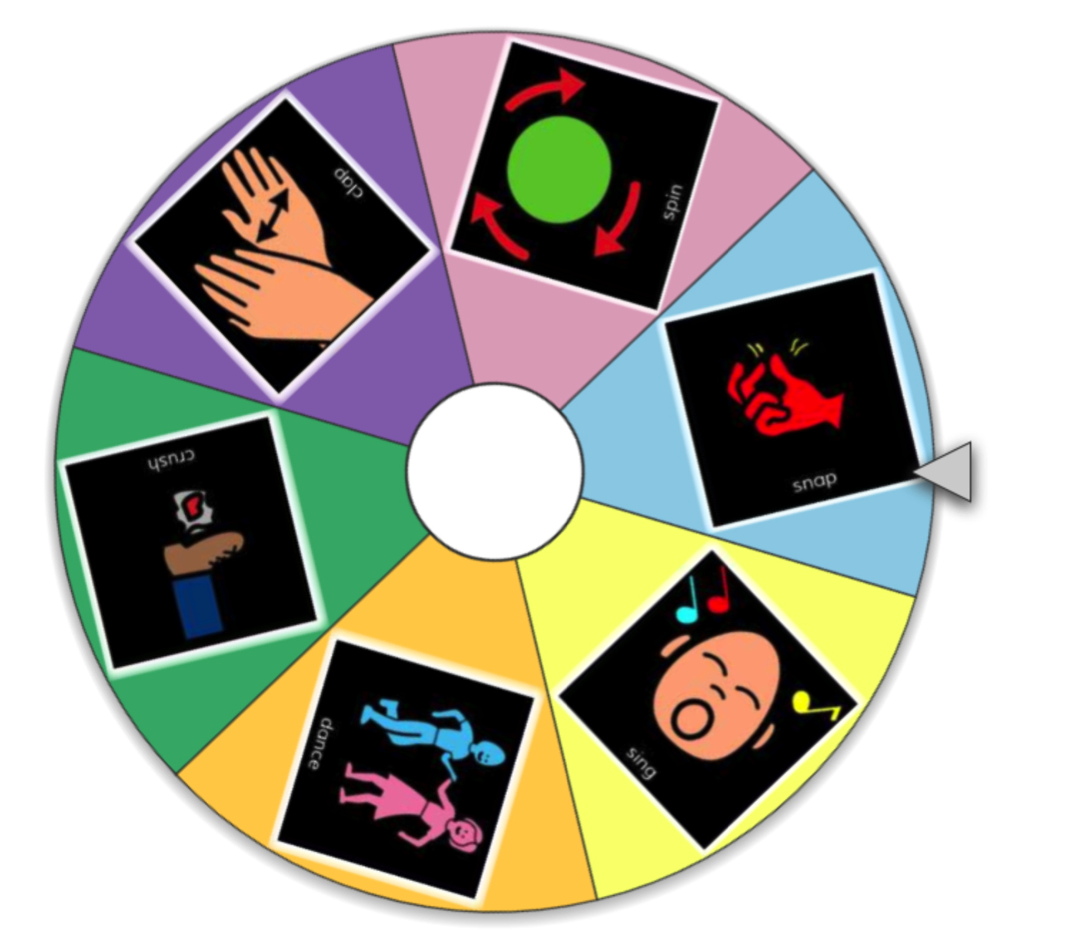
f.Actions for a Song:We added visual choices to the actions of the
song, I Have a Friend (Musselwhite, 2019, Singing to Learn CD/dropbox).Students spin to pick an action.
2. Customize Your Wheel.This is where the engagement features are
set up.Choose many features such as:
a.Dark Mode.I always keep dark mode on because it blocks
out distractions, and makes a dark background on which I can make annotations
such as typing words.
b.Music to Play During Spin.The default sound is ticking (boring!) Luckily, there are many interesting music
choices to pick from.
c.Length of Spin.Another ‘during spin’ choice is the length of
time.The default time is 10 seconds,
but I typically prefer 5 – 6 seconds.That’s enough time to enjoy the music without eating into my teaching
time!
d.After Spin Choices.You can set up choices for after
spinning.My default choices are shown
in the picture.I typically keep these
and do not reset them.
e.Background Colors.I have chosen primary colors, as seen on my
image.
f.Image in Center.You can use an image from their gallery or
upload your own image.For example, I
uploaded a picture of a car for the middle of a wheel to play ‘judge the rhyme’.
Spin a word, then judge if the new word
matches ‘car.’
3.Enjoy Your Wheel!I’m finding that this helps to add engagement
and ‘zing’ to our sessions, plus modeling print.Hope you enjoy it too.Leave a comment!
Just like in building construction, the right scaffolding can
support our emerging writers and communicators in reaching higher heights,
recognizing what the final product represents, and actively participating
during co-construction of poems. Examples of scaffolds are provided
through strategies we use in our mini examples. See, for example, Ben’s poem
about his dad for an example of partner assisted scanning.When his device wasn’t working,
Caroline’s fast thinking in creating a paper-based alphabet display for him
saved the day.
Many of our strategies reflect personally meaningful
connections, a scaffold to connect experiences and build language. Alexa
and her mother use a combination of spelling and symbols. They use the Word Finder to begin her
“Remember” poem, but once rehearsed she is able to more efficiently access the
word with icon sequencing for discussing and dictating her poem.
Other examples describe use of repetition, which
provides opportunities for multiple models and rehearsal, ultimately supporting
more efficient access to words. Sometimes we use a combination of light tech
and high tech writing or communication tools (previous
blog on light tech flip books can be found here),
observing how learners respond to the timing and feedback. Look for mini
examples with poems by Lily Grace.
We use the I-DAREacronym
purposefully to draw attention to the importance of immersion and demonstration
before expecting autonomous writing. We encourage our writers to take risks
because we are there to support them, and we can respond to what they share in
ways that reflect, respect, and elevate their words.
We can provide scaffolds throughout the writing process:
● selecting a topic,
● choosing a tool (or tools) for writing,
● finding more words on an AAC system,
● saving and sharing (publishing and celebrating)
For more ideas about I-DARE,
follow this LINK
to an USSAAC article I wrote.