Caroline's Rule of 6
This post has nothing . . . well, very little, to do with AAC or AT. Caroline's Rule of 6 is something I came up with years ago, because I tend to overreact (okay, freak out) when things go wrong. So, I devised a scheme to remind me, kind of like 'little problem / big problem' that we use for students with AAC.
Since my nephew David was in a serious bicycle accident and has been in a coma, I have been reminded of this and have been trying much harder to live by it. A friend asked me to share it, so here it is:
When something upsetting happens, ask yourself:
1 = Will it affect me in 6 minutes?
2 = Will it affect me in 6 hours?
3 = Will it affect me in 6 days?
4 = Will it affect me in 6 weeks?
5 = Will it affect me in 6 months?
6 = Will it affect me in 6 years?
If the answer to 3 - 6 are no . . . little problem!
You can also refer to this as 'The Power of . . . ' Thus, a problem that will affect you for 6 weeks is a problem to the power of 4 - whining allowed!!!!
Hope this is helpful. I'm thinking I might need a tattoo to help ME remember . . .
Friday, November 4, 2011

Monday, October 10, 2011
The Bridge Assessment

What Is The Bridge?
The Center for Literacy and Disability Studies describes The Bridge as: 'The an early literacy and language assessment framework based on observation and portfolio development/analysis.' We have found The Bridge both easy to administer and highly supportive of both progress monitoring and intervention planning.
Where Can You Download The Bridge?
The link below will lead you to the following:
https://www.med.unc.edu/ahs/clds/resources/early-childhood-resources-1/the-bridge-assessment
• Experimental version of The Bridge Protocol
• A guide to administering The Bridge
• PowerPoint presentations for training in use of The Bridge
• A list of action verbs to support observations
• PowerPoint presentations on book / writing adaptations
Developmental Spelling Test
Why Use Developmental Spelling Tests?
• Developmental spelling helps us understand what students are hearing in a word
• Research across languages, ability groups, and SES groups supports the concept that spelling is developmental
• This is relatively easy to test, using tests of 10 - 12 well-selected words
• Developmental Spelling Tests are especially useful for students who are nonspeaking, because we can get a window into their understanding
Where Can I Find A Developmental Spelling Test?
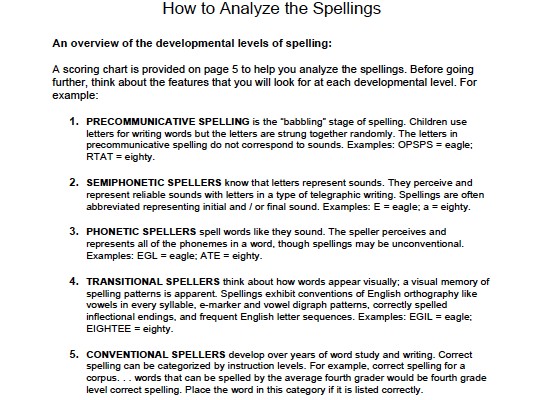
One test available online is the 'Monster Test' by Richard Gentry. This 10-word test includes words such as 'monster', 'united', and 'hiked.' A scoring guide is included, showing how to analyze spellings, to determine the developmental level (from precommunicative to conventional. The link to that test is below:
fourblock.wikispaces.com/file/view/Monster.Test.doc
Musselwhite & Hanser (2011, Write to Talk CD) suggest additional strategies for analysis such as:
• % onsets phonetically correct
• % vowels represented
www.aacintervention.com
Using Developmental Spelling Test Results
Results of the developmental spelling tests are great for:
• progress monitoring
• pre-post to determine success of an intervention
• In addition to administering a development spelling test, teachers and therapists can analyze student writing in context, using these strategies, and use results to guide instruction. For example, if the student has 83% vowels represented, but only 17% vowels correct, it is clear that s/he is beginning to 'get the vowel rule' (every word has a vowel), but needs instruction on how to determine the correct vowel.
Sunday, September 25, 2011
Fun Videos For Language and Literacy

Fun Videos: Girl Washing . . .
This video is a delight!! Enjoy watching it. Then share it with your children / students in some of the following ways:
• Language: Support students in:
- Sequencing: take screen shots and help students determine first, next, and last
- Narrative: re-tell this story
- Commenting: this video is fun for practicing making comments (sweet, uh-oh, oh no, yikes!)
- Core Words: this is ideal for summarizing using high frequency words (look at that. Is she bad?)
• Literacy: Support students in:
- Watching Response: Writing a response to this story
- Descriptive Narrative: re-tell this story
- Word Choice: describe the video using strong verbs and / or sparkle words
http://www.youtube.com/watch?v=yANjDEDcLvs
ZAMZAR – 1 Easy Way to Manage Movies
Most of you already have several ways to deal with movies, but I always have this question at workshops, so wanted to share the information here!
Question: How Do I Show Videos in School if I Don’t Have Access to Sources Such as YouTube?
Answer: You can download movies (with permission!) using resources such as Zamzar.

As you can see from the graphic, Zamzar can also be used for many other purposes! I often use it to convert files from one format to another. For example, let’s say that your camera saves videos in ..avi format, but you are using a program (ex: Classroom Suite ) that performs better with movies in a .mov format. This can be done quickly, easily, and for FREE for files under 100MB. The online directions are extremely clear, even for TechnoWienies!
Friday, August 12, 2011
Poem to Refrigerator Magnet!

Turn your poem into a refrigerator magnet! This is another in my series of celebrating creativity, both light and high tech. Remember, when you simply print a piece of writing, it goes on the refrigerator for 3.7 months, then goes into:
a) The Circular File (yes, the trash can), or
b) The Box . . . in the back of the closet
But if you turn your writing into a work of art, it will be enjoyed for longer, perhaps forever! Here are the steps for turning a poem into a refrigerator magnet.
1) Print out the poem, in smaller format (no larger than 5" x 7"). This shows a poem I wrote for my wonderful friend Harvey, for his birthday.
(Note: I did a list poem, using wordle. That is, words I wanted to be larger were typed multiple times. See directions in the April tip at my website:
http://aacintervention.com/tips/2009%20tips/tipnine.htm
2) Laminate the poem
3) Add stickyback magnet (from Michaels or other craft store)
This is inexpensive, but guaranteed to be a 'keeper'!
Thanks to Sarah Blackstone for this idea!
Thursday, August 11, 2011
Learning with Lennart - eye gaze video

Many of you will be familiar with the 'Learning with Lennart' series developed by Paul Andres, Prentke Romich (Germany), plus Lennart and his mom. This includes You Tube videos and presentations. The video shared below shares a simple and clear eye-gaze strategy. If you haven't discovered this series (in English and German), you should find them quite helpful. Enjoy!
http://www.youtube.com/watch?v=6_PgPFSV_hs
Subscribe to:
Posts (Atom)