Musselwhite Workshop List - And 30% Discount Through January, 2013!
I have some unexpected time in my schedule from November 1, 2012 - February 6, 2013. Anyone who books a workshop for that time period gets a 30% discount!
This could include:
• Workshops (1 day - multiple days)
• Consulting
• Project development
Follow the link below to get a listing of sample workshops.
Musselwhite Workshops Sample List
This blog is a companion to the website, www.aacintervention.com At this site, my friends and I will be sharing quick posts, minitips, and think outlouds! Please visit frequently, as this site will change rapidly!
WELCOME!
Please share this blog with your friends and neighbors!!
Dr. Caroline Ramsey Musselwhite
Saturday, September 15, 2012
Light Tech Backups for High Tech Devices
How are you handling light tech backup systems for individuals who have high tech devices with complex language systems such as Unity or Word Power? I am especially concerned about how to provide supports for students who use:
• Eye gaze or head mouse systems
• Switch scanning
When not well-positioned, these devices are typically just not available. I know this is NOT a new question, but I feel like the gap between 'in-the-chair' and in other positions such as on the floor, relaxing in a bean bag chair, and in bed is getting wider as we are more successful in supporting access.
It seems too much unguided 20 Questions happening. While PODD systems are amazing language systems, how would they translate for people who are already accomplished users of another language system?
Eagerly looking forward to a discussion and some great ideas!
• Eye gaze or head mouse systems
• Switch scanning
When not well-positioned, these devices are typically just not available. I know this is NOT a new question, but I feel like the gap between 'in-the-chair' and in other positions such as on the floor, relaxing in a bean bag chair, and in bed is getting wider as we are more successful in supporting access.
It seems too much unguided 20 Questions happening. While PODD systems are amazing language systems, how would they translate for people who are already accomplished users of another language system?
Eagerly looking forward to a discussion and some great ideas!
Friday, September 14, 2012
Balanced Literacy Workshop!
Balanced Literacy Workshop in Phoenix - only $30!
Just trying to spread the word that Deanna & I are doing a one-day overview of the Balanced Literacy Club project. This workshop in intended for professionals and parents supporting students who:
• Use or need augmentative communication devices
• Are beginning readers (reading & writing below the 2nd grade level)
Check out the link to the flyer.
Balanced Literacy Workshop Flyer
Caroline
Just trying to spread the word that Deanna & I are doing a one-day overview of the Balanced Literacy Club project. This workshop in intended for professionals and parents supporting students who:
• Use or need augmentative communication devices
• Are beginning readers (reading & writing below the 2nd grade level)
Check out the link to the flyer.
Balanced Literacy Workshop Flyer
Caroline
Sunday, January 15, 2012
AppHappy

Just wanted to make sure that my blog followers know about Maria Kowch's blog as AppHappy. She's a brilliant mom, yoga instructor, and looks at apps with a clear eye. Our group in Phoenix has learned so much from her!
http://apphappy.posterous.com/
For example, Maria gave us a heads up about the MYB (move your body) or eye tracking games that are out there. FUN! With so many new apps each week, and so many apps blogs to track, I just can't keep up. But Maria is really helping!!!
Friday, November 4, 2011
Caroline's Rule of 6
This post has nothing . . . well, very little, to do with AAC or AT. Caroline's Rule of 6 is something I came up with years ago, because I tend to overreact (okay, freak out) when things go wrong. So, I devised a scheme to remind me, kind of like 'little problem / big problem' that we use for students with AAC.
Since my nephew David was in a serious bicycle accident and has been in a coma, I have been reminded of this and have been trying much harder to live by it. A friend asked me to share it, so here it is:
When something upsetting happens, ask yourself:
1 = Will it affect me in 6 minutes?
2 = Will it affect me in 6 hours?
3 = Will it affect me in 6 days?
4 = Will it affect me in 6 weeks?
5 = Will it affect me in 6 months?
6 = Will it affect me in 6 years?
If the answer to 3 - 6 are no . . . little problem!
You can also refer to this as 'The Power of . . . ' Thus, a problem that will affect you for 6 weeks is a problem to the power of 4 - whining allowed!!!!
Hope this is helpful. I'm thinking I might need a tattoo to help ME remember . . .
This post has nothing . . . well, very little, to do with AAC or AT. Caroline's Rule of 6 is something I came up with years ago, because I tend to overreact (okay, freak out) when things go wrong. So, I devised a scheme to remind me, kind of like 'little problem / big problem' that we use for students with AAC.
Since my nephew David was in a serious bicycle accident and has been in a coma, I have been reminded of this and have been trying much harder to live by it. A friend asked me to share it, so here it is:
When something upsetting happens, ask yourself:
1 = Will it affect me in 6 minutes?
2 = Will it affect me in 6 hours?
3 = Will it affect me in 6 days?
4 = Will it affect me in 6 weeks?
5 = Will it affect me in 6 months?
6 = Will it affect me in 6 years?
If the answer to 3 - 6 are no . . . little problem!
You can also refer to this as 'The Power of . . . ' Thus, a problem that will affect you for 6 weeks is a problem to the power of 4 - whining allowed!!!!
Hope this is helpful. I'm thinking I might need a tattoo to help ME remember . . .
Labels:
Caroline's Rule of 6,
Power of 6
Monday, October 10, 2011
The Bridge Assessment

What Is The Bridge?
The Center for Literacy and Disability Studies describes The Bridge as: 'The an early literacy and language assessment framework based on observation and portfolio development/analysis.' We have found The Bridge both easy to administer and highly supportive of both progress monitoring and intervention planning.
Where Can You Download The Bridge?
The link below will lead you to the following:
https://www.med.unc.edu/ahs/clds/resources/early-childhood-resources-1/the-bridge-assessment
• Experimental version of The Bridge Protocol
• A guide to administering The Bridge
• PowerPoint presentations for training in use of The Bridge
• A list of action verbs to support observations
• PowerPoint presentations on book / writing adaptations
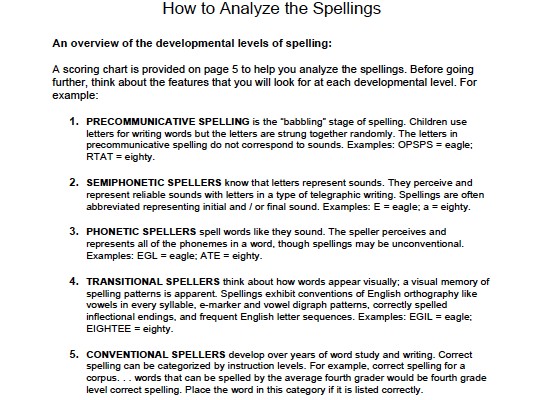
Developmental Spelling Test

Why Use Developmental Spelling Tests?
• Developmental spelling helps us understand what students are hearing in a word
• Research across languages, ability groups, and SES groups supports the concept that spelling is developmental
• This is relatively easy to test, using tests of 10 - 12 well-selected words
• Developmental Spelling Tests are especially useful for students who are nonspeaking, because we can get a window into their understanding
Where Can I Find A Developmental Spelling Test?
One test available online is the 'Monster Test' by Richard Gentry. This 10-word test includes words such as 'monster', 'united', and 'hiked.' A scoring guide is included, showing how to analyze spellings, to determine the developmental level (from precommunicative to conventional. The link to that test is below:
fourblock.wikispaces.com/file/view/Monster.Test.doc
Musselwhite & Hanser (2011, Write to Talk CD) suggest additional strategies for analysis such as:
• % onsets phonetically correct
• % vowels represented
www.aacintervention.com
Using Developmental Spelling Test Results
Results of the developmental spelling tests are great for:
• progress monitoring
• pre-post to determine success of an intervention
• In addition to administering a development spelling test, teachers and therapists can analyze student writing in context, using these strategies, and use results to guide instruction. For example, if the student has 83% vowels represented, but only 17% vowels correct, it is clear that s/he is beginning to 'get the vowel rule' (every word has a vowel), but needs instruction on how to determine the correct vowel.
Subscribe to:
Posts (Atom)