Social Communication:
Adolescents & Adults Developing/Expanding Communication Skills
Part 1: Social
Commenting
by Deanna K. Wagner,
MS/CCC-SLP
for the Angelman
Syndrome Foundation Biennial Conference, July 2017
Summary
This session will provide ideas strategies to expand on
social skills that help the emerging communicator establish and/or maintain
relationships by not focusing primarily on requesting behaviors. Instead of asking the person to request
cereal, we can encourage extended social engagement by encouraging and
practicing commenting forms of recurrence, negation, and disappearance. And when we notice smiling and laughing when
playing, we help/encourage more traditional symbolic ways to say “like.”
Learning Objectives:
1.
Participants
will list at least 3 social functions of communication (beyond requesting) and
describe why it is important to move beyond requesting.
2.
Participants
will describe how idiosyncratic and non-symbolic behaviors are communicative
attempts by emerging communicators.
3.
Participants will be prepared to share at least
one personal example of idiosyncratic or non-symbolic social communication.
The first thing we need to keep in mind is that everyone
communicates. Through the Communication Matrix, we can
explore whether they are using idiosyncratic or symbolic means, and in all situations
we need to be good investigators and observe both what and why they are
communicating. There are paper-based and
on-line forms for the Matrix. Below is a
screen shot of the standard view of a teenager who uses conventional
communication to make choices, ask for “more” of an object and answers yes/no
questions because she can nod her head and look at what she wants. She is learning to use an eye gaze communication
system, and therefore her ability to request more of an action or to ask a
question is still emerging. She is also switching
from using more concrete symbols to using abstract symbols on her device for a
variety of purposes: refuse/reject something,
request more, request a new action or object, request attention and show
affection. Since she is very social (see
that she has mastered “greeting people”), we are not limiting her symbols to
only those that can be represented concretely, and she is using the abstract
symbols purposefully (though inconsistently, since she is still learning).

Here is my main precaution when using the Communication
Matrix. Use the Communication Matrix so you can have a Skills List of specific
behaviors, but please don’t consider it a hierarchy that all students need to
pass through. Requiring mastery of
concrete symbols before moving on to abstract symbols could limit learning
opportunities. For students who truly
need 3-D symbols, please see my entry on our AAC
& Balanced Literacy Wikispace and check out the tactile symbols on the Project Core website.
The PragmaticsProfile by Hazel Dewart and Susie Summers is also a great way to document how somebody
is communicating. There is a preschool
and a school-aged interview form. The
questions would also apply to adults who are learning to use alternate forms of
communication. Similarly, you could use
the AAC
Profile by Tracy Kovach to evaluate skill levels of the AAC user as well as
communication partners as they relate to linguistic, operational, strategic,
and social skills.
Consider purposes of communication (Light,
1988): Expression of needs/wants; Information transfer; Social closeness;
and Social etiquette. And consider
communicative functions (Vantatenhove,
2016). Even when communicating at
the one-word level, young typically-developing children can express multiple
functions: Greet or Part (hi/bye),
Request Assistance (help),
Recurrence (more), Naming-Labeling, Existence (this, look), Nonexistence (gone),
Disappearance, Rejection, Cessation (stop), Comments (like, yuck), Vocatives
(mama, papa, baby),
Directive (help), Associative (up).
So, as we start our journey encouraging the first words on
an AAC device and decide to focus on what are referred to as “core words,” we
must be careful to remember to encourage their expressive attempts and model
multiple reasons for communicating, keeping in mind the importance of the
social aspects of these behaviors. When
a child reaches for something, we help him or her to say “want;” and if we
notice smiling and laughing when playing, we help/encourage more traditional symbolic
ways to say “like.”
How about recurrence?
We can engineer the environment so it is necessary to ask for “more” of
something. I do this frequently when we
are cooking, since we usually make this into a social activity. I set the timer on the blender for just a few
seconds and then wait. Or I don’t add
enough sugar and offer everyone a taste.
We also make computer time social.
Sometimes we use “turn the page” in an electronic book, or play/pause
for YouTube videos. I have even been
known to e-mail instructions and leave out the last steps so it is obvious that
somebody needs to ask me, “What’s next?”
Check out the Anatomy of a Conversation as described in the Can
We Chat Book by Caroline Musselwhite and Linda Burkhart, available from
TeachersPayTeachers. Here are suggested
conversational messages from 2001. Do
you think they have changed much?
The more we understand and can navigate a robust
communication system, the more we can model social forms of expression. Check out the ways we can expand and model
social engagement using expressions on multiple devices.Please don't be concerned that the device you have is right or wrong, just remember to look for opportunities to practice social skills.
·
If using a device with icon sequencing, such as Words for Life, practice concepts linking
from the LIKE icon, such as laughing, jokes, and fun. Or INTERJECTIONS –
awesome, very good.
·
If using Proloquo2Go, be
sure to check out the positive expressions pages (fun, cool, great, This is
fun, I’m joking).
·
And in PODD communication books,
the early and expanded functions books have whole pages with ways to say, “I
like that” (e.g., clever/smart, fun, I like that). The iPad app is called Compass
with PODD from Tobii Dynavox, and it also has these pages.
If using TouchChat
with WordPower, be sure to check out the Chat Pages from TALC AAC (Jill
Senner). Explore
expanded/organized social pages from WordPower 20, 24, 42, 42Basic, 48,
60Basic, 60. These pages have been designed to expand availability of
vocabulary to allow people who use AAC to perform a variety of pragmatic
functions such as making/responding to greetings to/from others, maintaining
topics using typical responses, and asking for/responding to requests for
clarification during conversation. These pages provide quick words and phrases
for participation in time-dependent activities, such as making a phone call,
while still providing access to core vocabulary. The following pages are
included: starters/greetings, closers, conversational maintainers, regulation
vocabulary, social questions, repair strategies, manners, telephone and news. The page of maintainers include some nice
examples of positive, neutral and negative comments.
Video how-to link here: https://www.youtube.com/watch?v=KkOhug-4Swg
Download file here: Social
Pages for use with WordPower on TouchChat/NovaChat devices
The AAC users that I work with at an Adult Day Program
(ValleyLife AZ) love making comments on social media. We check out Facebook photos and YouTube
videos. We practice responding to the
prompt, “What do you think?” I also
encourage their communication partners to ask them this question throughout the
day. This draws out an opinion or
comment rather than responding “yes” or “no” through body language to the
question, “Do you like it?”
Moving on to negation…
It is critical that our students learn to say “bye”, to indicate they
are finished, and to tell us when they don’t like something. If they don’t figure out how to do this by
using language, they will tell us by using body language and behaviors. Again, the Matrix or the Pragmatic Profile
will give us a snapshot of how this student is communicating. Also helpful is the Student
AAC Profile by Gail Vantatenhove, since this includes data forms so that we
can see whether opportunities have been provided and indicate what form of
communication the student chooses to use across multiple days.
I have had lots of fun helping the adult clients I work with
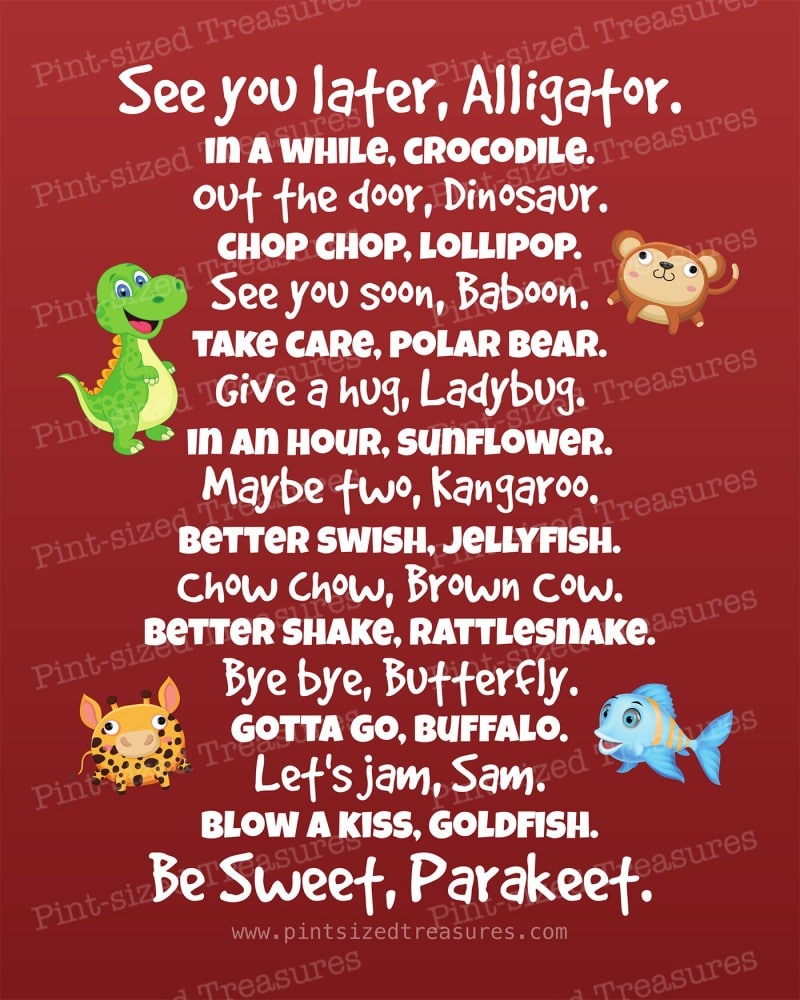
personalize the messages that they use for saying bye. Here are a few: Bugs Bunny farewell, Arnold the Terminator
saying “hasta la vista, baby”, bye-bye butterfly, Daffy Duck saying “I’m outta
here”, gotta go, guess I better go now, see you later, take care of yourself,
etc.
Here is a link to some you may find fun:
References:
Light, J. (1988). “Interaction involving individuals using
augmentative and alternative communication systems: state of the art and future
directions”, AAC, 4, 2, 66-82